The Purpose of a Sketchbook: Why You Should Keep One
In this article, I'll be writing my thoughts on why a sketchbook is an Overpowered Monster, where the majority of the artistic magic growth happens, and why the sketchbook is one of the best tools for a human being to become an artist who grows creatively, skillfully, and mentally. If you want to get better at art in general, learn to draw, learn the art principles, and become better artistically, the sketchbook is the answer, ehm... half of the answer xd. The sketchbook is one of the major tools that envelopes everything like a triangle of the other important internal parts (the other half). But, let's now focus on the sketchbook primarily..
Why Sketchbook?
For us artists, to get better or to create, we need a place where we can do so, a surface that we can make marks on. This place is then used with either a creative approach, a studying approach, or both simultaneously. With both approaches interchangeably, we make marks on the surface. These marks fill the page and become something in the end. This something, whatever the final product will be, what matters is not the final product, but the approach that was used while working the page out, by using this "place" where we've used these marks to fill the page. This place, in general, is called the sketchbook, a place that comes with blank pages that have the purpose of becoming filled with something.
About The Practical Approach
The practical approach is focused on using the sketchbook page for practice, studying, experimentation, and exploration. Its overall approach is more focused on the practical side.
The core benefit of this practical approach is the power of studying and practicing things related to art in general. Two major building blocks associated with this are the Visual Principles and Design Principles, as well as the way we see and think through them.
About The Creative Approach
The creative approach is focused on using the sketchbook page to create something that has emphasis on being more creative and refinement, feeling more like a finished artwork.
Creative approach does use the parts of the practical approach that were gained through practice. The parts become the tools, that become mixed.
Interchangeable Roles
Both Practical approach and Creative approach have interchangeable role and create a strong relationship. The practical approach helps to understand things and build a set of tools that are being used to help us to create. The tools, as they become more practiced, become more craftsmanship-driven, which increases their applicability that reflects through the creativity later on.
The Sketchbook Secret
The secret of the sketchbook is using it to develop mentality. The way we think and approach things is what shapes the sketchbook page and ultimately becomes the final result, whether the page ends up finished or unfinished. The true power of the sketchbook lies in building “mental tools” and later using them creatively. Each sketchbook page opens up a new drawing session where we can experiment with different mentally driven approaches. This mentality shapes the way we think, which then becomes the process, the approach, and eventually the habit. Over time, these habits form specific tools or sets of tools and solidify them through repetition.
Below is a diagram with a sketchbook page showcasing the flow behind the drawing session.
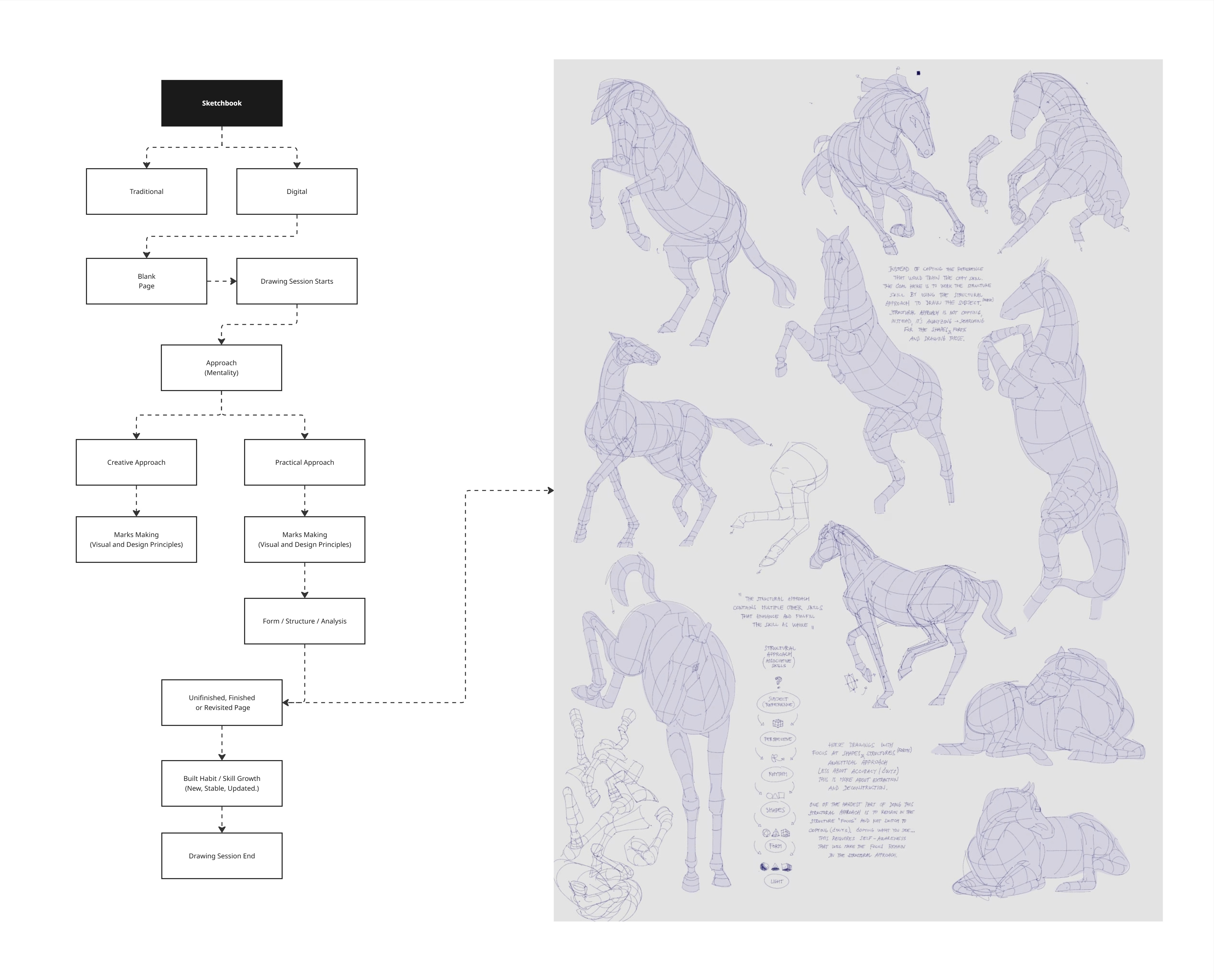
The drawing session above in the diagram was done digitally instead of traditionally. Starting with a blank page, I approached it with a practical mentality that leans more toward practice and study rather than creativity. This practical approach using mark-making, specifically line, cross-contour, and form, which was the primary purpose of the page. The focus was on analyzing shapes and forms and drawing them through line work.
The page was completed over two sessions; otherwise, it would have remained unfinished, which is a bad habit I used to have and am trying to avoid. This page was not meant to look polished or refined. The goal was to focus on practical aspects and visual principles, specifically form. This mentality helped train and reinforce the habit, making the skill more solidified, refined, and easier to apply in the future whenever a specific situation calls for it through practiced knowledge.
The sketchbook was the primary tool where this entire process was forged, and that is the secret of the sketchbook and why it is so powerful.